
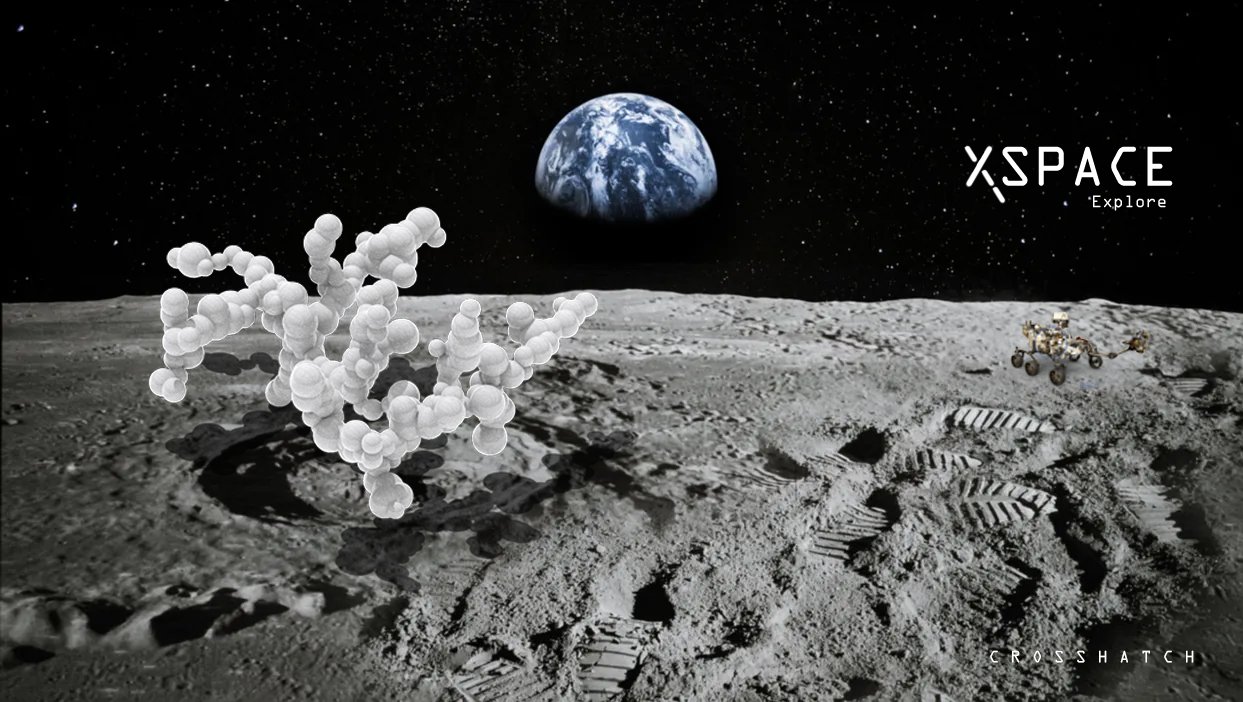
XSPACE
Aerospace
Wormwood
Seed [1.0]
Self
growing, Indigenous system
Zeeshan
Javed

We reached in cosmos with
all the advancements and efforts of current technologies, in search of
multiplanetary for living human race. That was just the journey part,
destination is still long way ahead. Making celestial fabric that grow into
thriving self-sustaining habitats. Thus brings the architecture that grows
itself, poised to revolutionize how humanity colonize to stars.
As the Human race evolved, their
curiosity and exploration for universe increases. Cosmology and astronomy is
not the new thing for humans. In search of new lifeform and space exploration,
humans made lot of technological advancement to reach these galactic objects.
Inhabitable space have been constrained by the immense challenges of
transporting and assembling complex infrastructure beyond earth. Currently we
rely on prefab modular structure that we transport from earth to space. Which
utilize lots of expense and energy. Therefore if we want habitat in space we
need to utilize its local resources and bring such indigenous building system
that involve less human interference. An autonomous system that can grow and
organize according to the environment, specifically to any celestial object.
The need of such groundbreaking solution is the stepping stone for long-term
lunar bases, Martian colonies, Titan prospects and beyond.
This is where Self-growing,
indigenous and autonomous space architecture comes in, a adaptive solution,
inspired by nature, that grows and adapt within. Imagine a computational
conscious system who bio-mimic the nature and bring all the advance materials
and growth system, that architecture form is not only reducing transportation
costs, ensuring structures can adapt to their surroundings and opening doors to
more sustainable and scalable extraterrestrial settlements.
The objective of this paper is
to delve into the revolutionary concepts, a system that inspired from nature
and mirrors its ability to grow and adapt. Thus bringing advance computational
techniques that will the solution to the constraints, that humans are facing in
the space colonization.
Space exploration has historically
relied on pre-fabricated modular systems for constructing habitats such as International
Space Station (ISS) or proposed Martian base concepts. These modules are build
on earth , requiring precision engineering and immense resources. Now
transporting them, involves lot of expense, more trips depending on the scale
of structure. Adding more, these pre-fab designs struggle to adapt to dynamic
extraterrestrial environments like mar’s dust storm, radiation or unanticipated
terrain changes. Dependences on Earth- sourced materials and technologies
limits the feasibility of establishing truly independent extraterrestrial
colonies.
Self-Growing Space Architecture:
The need of an innovative,
self-sustaining system is clear. This is where the concept of self-growing
space architecture solution becomes transformative. The proposed system is
inspired by biomimicry-imitating the adaptive and resource efficient growth
processes found in nature.
Self-growth mechanism, utilize
programmable material that can autonomously grow and reshape itself in response
to environmental stimuli, similar how microbes and plants grow in varying
conditions. Leverage additive manufacturing (3d printing) combined with in-situ
resource utilization to “grow” the structure using available resources on Lunar,
Martian, Titan soil.
Autonomy: Integrate AI and robotic
systems capable of monitoring, decision-making, and facilitating the growth and
adaptation process. Implement sensor
networks to continuously assess environmental conditions (e.g., temperature,
radiation) and adapt accordingly.
Adaptability: Develop architectures
that evolve based on the specific needs of the habitat, such as expanding
living areas or creating radiation shields.
Allow the structure to repair itself or modify its shape when
encountering environmental stresses. The growing structure will
monitor its boundaries (e.g., allocated space, stress thresholds) and adjust
its growth pattern to remain within safe and functional limits.
Sustainability: Significantly reduce
reliance on Earth-based resources by growing habitats directly on-site. Promote the reuse of materials and
energy-efficient processes for long-term habitation.
Design Methodology:
In
this project, we used Rhino3d and python as primary tool for crafting the macro
scale, dynamic self-growing space architecture. The core idea of the design
lies in its simple logic of point geometry
with respect to some parameters and scenario that that shape up into a
complex geometry.
The
process began with defining simple start point geometry, which is the actual
seed, that will grow. We took celestial craters as the locations. Our system
will grow till it found the boundary. Circumference of crater is acting one of
the boundary parameters. With the study of celestial body atmosphere like
gravitation, oxygen, nitrogen, radiation level, soil chemistry, Through systematic adjustments and
computational logics with respect to atmospheric parameters. This approach
allowed us to explore the potential of a self growing architecture system- one
that can adapt to different celestial environment conditions, or other
contextual factors. These responsive , organic growth structure resulting a
seamless fusion of simple geometry to complex computational geometry, embodying
the essence of innovation in architecture design.
Thats
a macro scale objective, then its microscale mechanics. A single cell structure
acts as a living pod and putting that macro structure in a actual living
habitable space. Every cell is self sustain and living being within the larger
macro-structure. Its properties are designed to ensure adaptability growth and
resilience in a self growing architectural system.
Technical Details of Self-Growing Space Architecture.
The
self-growing space architecture proposed here introduces key innovations
derived from your Rhino-based growth system design:

Adaptive Growth Process:
Direction-Based Movement: The drawPts
function in code enables flexible growth
along different axes (X, Y, Z), guided by random or intentional directions.
This allows the architecture to grow adaptively in response to environmental
inputs (e.g., gravity, resource availability, or stress conditions).
Randomized and Autonomous Adaptation:
By incorporating randomness (random.uniform and random.choice), the system can
explore multiple pathways, adapting to unpredictable environmental constraints,
such as uneven Martian terrain or changes in resource distribution.
Boundary Confinement and
Self-Regulation:
The reflectWithinCurve function
ensures growth remains within predefined spatial limits. This concept can
translate into autonomous boundary regulation in real-world applications, where
sensors monitor the structure’s integrity and ensure expansion stays within
safe, functional constraints.
For example, a growing habitat could
automatically adjust its expansion when it reaches proximity to hazardous
terrain or other structures.
Material Differentiation:
The calculateRadius and assignColor
functions dynamically assign properties (radius and color) based on the
distance from the origin. This mirrors a material optimization system, where
the architecture autonomously determines the thickness, density, or functionality
of different sections based on environmental factors like radiation,
temperature, or load-bearing requirements.
For instance, thicker walls could
form in high-radiation areas, while thinner sections are used in less critical
zones.
Autonomous Decision-Making and
Resource Utilization:
The decision-making in your code
(e.g., choosing growth direction and randomizing points) can be translated into
AI-based algorithms that enable real-time, data-driven adjustments during
construction. The AI would analyse inputs from onboard sensors and execute
optimized growth patterns.
Coupling this system with in-situ
resource utilization (ISRU) ensures the habitat “grows” using local
materials like Martian soil, minimizing reliance on Earth-based resources.
Self-Repair Capabilities:
The ability of your system to iterate
and grow new points offers a potential framework for self-repair mechanisms. If
sections of the structure are damaged, the system could identify the issue and
grow replacement parts autonomously.
Proof
of concept results and simulations.
Growth Algorithm: The iterative
point placement and directional choices demonstrate how an autonomous system
can grow complex structures in a controlled yet flexible manner.
Boundary Management: The ability
to reflect points within a curve proves the feasibility of spatial
self-regulation.
Material Differentiation:
Dynamically assigned radii and colours illustrate how growth systems can
allocate resources or properties based on environmental data.
Real-world
Industries or Fields that benefit.

Aerospace and Space Exploration:
NASA, SpaceX, or other space agencies
and private organizations can leverage this innovation for extraterrestrial
missions.
Civil Engineering and Architecture:
Urban planning and disaster
management authorities can deploy self-growing systems to tackle housing
shortages and post-disaster recovery.
Défense and Security:
Military installations in remote
areas or harsh climates can use self-growing systems for autonomous
fortifications.
The principle in growth system design—adaptive
expansion, boundary regulation, and material differentiation—present practical
solutions to diverse real-world challenges. This architecture doesn’t just meet
the demands of futuristic space missions but also addresses pressing issues
here on Earth, offering scalability, sustainability, and resilience.